
Podcast Episode 0112 - The Cost of Information Exchange – Part 2: Replacing the Meeting Without Losing Alignment
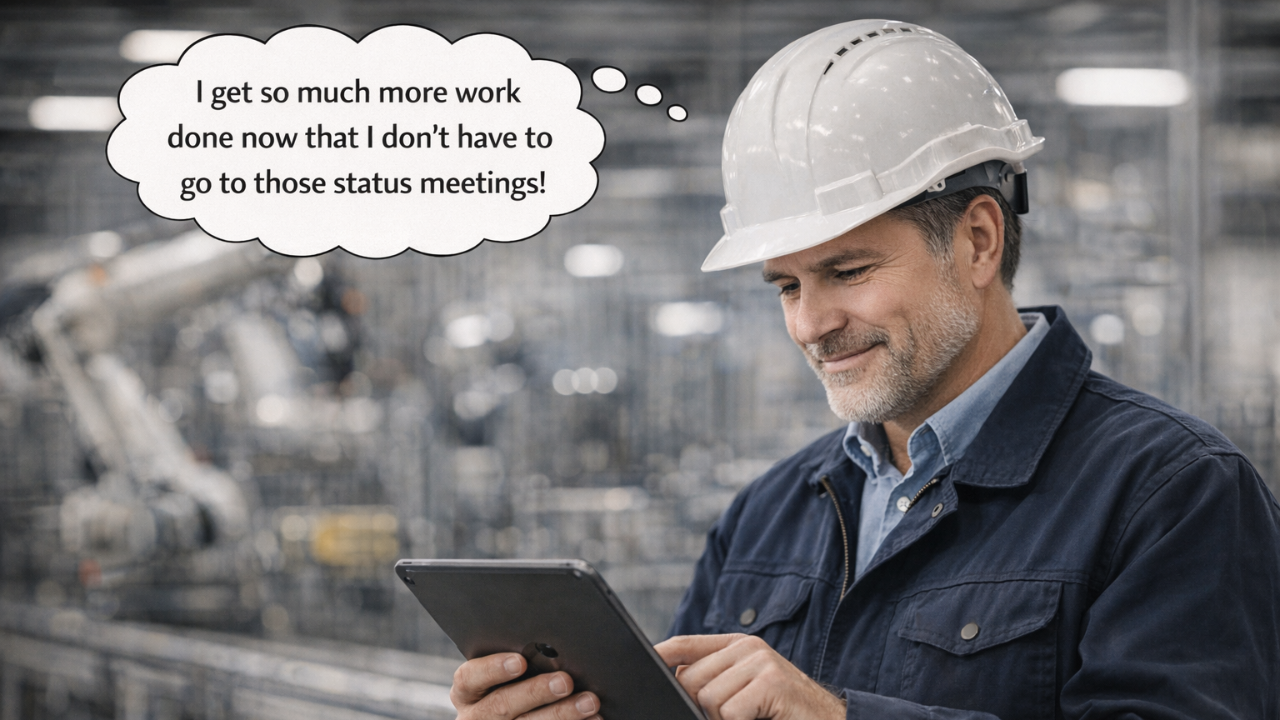
Hey everyone, I’m Annie Rynd and you’re listening to the 1,001 Business Problems Solved with Microsoft Teams podcast. I hope it’s finally feeling like spring where you are; we’ve had a bit of a setback here in southern Indiana where we actually had to load more firewood into the stove.
Anyway, let me tell you where we stand after last week.
In that first episode of this series, we talked about a familiar kind of meeting — the ones organizations of every size rely on to get everyone oriented and on the same page. We put words to something most leaders sense but rarely articulate: the meeting itself was never the goal. The real goal was orientation and synchronization.
When information isn’t visible anywhere else, meetings become the only practical way to reconstruct reality, and the calendar quietly turns into the glue holding the picture together.
Today, in Part Two, I want to make this idea practical. I want to show you what it looks like to replace the meeting itself, without losing that precious alignment leaders are trying to protect — and I’m going to do it using the same kind of high stakes example I used last time, because nothing reveals the cost of meeting for orientation faster than an outage where the clock is running.
Let me start with a picture you can probably recognize.
The outage or maintenance shutdown is underway. Everyone is busy. Work is happening across multiple crews and locations. And instead of pulling everyone into the conference room for another update meeting, something different happens.
Either at the end of the previous day or at the start of the current one, a member of each crew enters a short, structured update where the work actually lives. What was completed. What changed. What’s blocked. What needs attention.
The people closest to the work can capture updates right where they are, while context is still fresh — instead of trekking back to an office just to type them up later.
No speeches. No storytelling. Just facts and context.
As those updates come in, leaders don’t have to chase them. They can see a shared picture forming in real time. If they want a high level snapshot, it’s there. If something catches their attention, they can drill into the underlying details — including the conversations and context behind that update — and follow the thread straight to the people doing the work. If they need clarification, they can ask the right person directly, without interrupting everyone else.
And here’s the important part.
Synchronization still happens.
Everyone is aligned to the same truth. The same updates. The same decisions. The same priorities.
But physical attendance is no longer the price of admission.
No one has to walk away from active work just to get oriented. No one has to sit through updates that don’t apply to them. Meetings still exist — but only when discussion or decision is actually required.
For smaller organizations, this might show up as a weekly staff update that no longer consumes the entire meeting. Or a project review where everyone arrives already oriented, because the updates were written down and visible ahead of time.
Different scale. Same benefit.
Alignment without constant interruption.
Now, that might sound too simple, so let me slow it down and show you what’s really happening here.
Most recurring meetings have two very different purposes that get mashed together.
The first purpose is orientation. That’s the part where everyone is trying to answer, “What changed since yesterday? ” “What’s stuck? ” “What moved? ” “What do I need to know that I don’t know? ” It’s not glamorous, but it’s non negotiable.
The second purpose is discussion and decision. That’s the part where leaders weigh trade offs, solve problems, make calls, assign owners, and create forward motion.
In most organizations, we try to do both of those things in one sitting, in one room, with one large group.
And that’s where the hidden cost shows up.
Because orientation is mostly one way information exchange. It doesn’t require everyone’s judgment. It requires everyone’s awareness.
So when you use a meeting to provide orientation, you force everyone to pay for awareness with physical disruption, calendar disruption, and mental context switching. You don’t just spend the thirty minutes. You spend what it takes to leave the work, walk away from problem solving, sit through what doesn’t apply, and then re enter the work afterward.
Replacing the meeting doesn’t mean replacing discipline. It doesn’t mean loosening control. It means separating orientation from discussion, so each can happen in the place it works best.
So what does that look like in practice?
It looks like this: you take the orientation part — the updates — and you capture them where the work information lives, in a shared place, in a predictable format.
Then, leaders and teams interact with those updates in the flow of real work.
They skim what they need. They drill down when something looks off. They ask clarifying questions only when necessary. They pull the right people into a targeted conversation when a decision truly needs to be made.
In other words, you stop requiring everyone to assemble just to reconstruct reality.
And once you do that, meetings start shrinking naturally. Not because you forbid them and not because you “ optimize ” them. But because the only reason you needed them so often was to get everyone oriented in the first place.
Now, if you’re listening from a smaller organization, this is where I want you to resist the temptation to say, “Well, we’re not a power plant or big manufacturer. We don’t have crews. We don’t have outages .”
Because the mechanism is the same anytime the leader of the organization — or one key employee — has to be physically present just to keep the picture intact.
If your weekly staff meeting exists primarily to exchange updates, you’re doing the same thing. If your project sync is ninety percent status and ten percent decisions, you’re doing the same thing. If people say, “We can’t make progress until we all get on the same page, ” you’re doing the same thing.
And the alternative is the same too.
Capture the update where the work lives.
Make it visible.
Then meet only when discussion or decision is required.
That is what replacing the meeting really means.
It’s alignment without constant interruption.
And it builds directly on the calm assertion we ended with in Part One: synchronization is non negotiable, but forced physical and cognitive disruption is not.
Now, here’s the catch — and it’s the part most organizations skip.
This doesn’t happen by accident.
Information has to be written down clearly, stored predictably in a shared environment, and easy to retrieve. Otherwise, those “ updates ” turn into just another layer of scattered notes, and leaders end up right back where they started — chasing clarity.
So in Part Three, we’re going to talk about the environment that actually makes this work. What it means to have the work itself exist in a shared place. What “ structured updates ” look like when they’re designed in a way leaders can trust. And why this is, at its core, an information design problem long before it ever becomes a meeting problem.
Seen that way, these first two episodes have really been about naming a quiet truth many leaders have felt for years: meetings often become an expensive, disruptive stand in for visibility. Next week, we’ll get concrete about how you can use the Microsoft tools you already have to break that pattern — and dramatically reduce the time and energy meetings consume.
If today’s episode helped you picture a world where meetings are optional instead of mandatory, stay with me.
I’ll see you next Monday — and we’ll take the next step in the sequence: how to design visibility so orientation becomes easy, and meetings finally return to their rightful job… decision and forward motion.
This is Annie, signing off!.
Stay connected!
Join our mailing list to receive cutting edge content.
Don't worry, your information will not be shared.
Categories
All CategoriesThe Author

Arnie Howes
Arnie Howes has spent more than 25 years working with hundreds of organizations, using Microsoft collaborative technologies and Lean Office techniques to eliminate email overload and information chaos.
Receive cutting-edge content from the author!
