
Why Leaders Struggle to Get Traction with AI—and How to Break the Stall

Many leaders are curious about AI, especially tools like Copilot, but still feel stuck. They’ve tried it, heard about it, or watched others experiment with it, yet it hasn’t delivered the clarity or leverage they expected. The issue usually isn’t intelligence, effort, or even willingness—it’s orientation. Without a clear way to think about AI adoption, leaders often bounce between skepticism, overwhelm, and uncertainty.
A helpful way to understand this pattern is through a simple four‑square matrix that has been widely discussed in technology and innovation circles. One axis represents optimism about what the technology can do, ranging from pessimism to confidence. The other represents focus, moving from vague impressions to clearly defined problems. Most leaders move through these quadrants in a predictable clockwise pattern. Some start with focused pessimism after a disappointing first experience. Others sit in vague pessimism, convinced AI will never be able to support real leadership work, even if they can’t point to a specific failure. Many land in vague optimism—believing AI could help, but feeling frozen by its breadth and power.
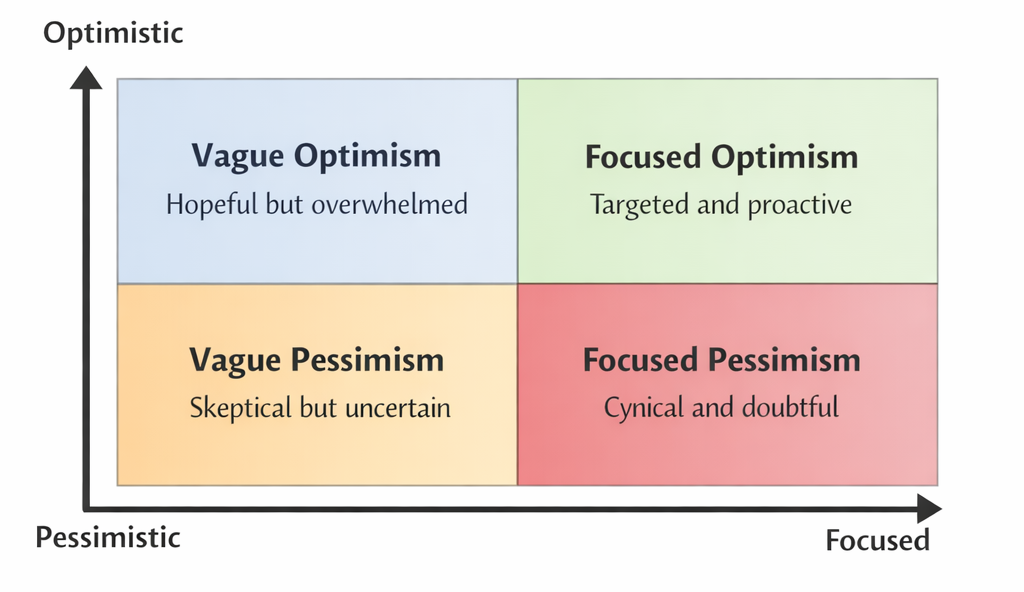
Real progress begins in the final quadrant: focused optimism. This is where leaders stop trying to “learn the software” and instead choose one real, recurring problem that already costs them time, clarity, or energy. When AI is aimed at a specific leadership friction point—rather than treated as a general‑purpose novelty—it starts to feel useful instead of abstract. The shift is subtle but powerful: from exploring features to solving problems, from floodlight to flashlight.
There is an important caveat that often gets overlooked. AI tools can only work with what they can see. If decisions, updates, and handoffs are scattered across inboxes, side conversations, and people’s heads, AI is forced to guess. That’s when answers feel thin, incomplete, or even wrong. In practice, the biggest gains don’t come from better prompts or deeper tool training; they come from structuring information so the organization becomes legible. When work is written down clearly in shared places, AI stops guessing and starts reasoning.
The bottom line is simple. With AI—just like with any other organizational technology—the greatest leverage comes from focusing first on the problem you’re trying to solve, not on learning the tool itself. When leaders flip that order, AI stops feeling like one more thing to figure out and starts becoming a practical partner in clearer thinking, better decisions, and less daily friction.
Stay connected!
Join our mailing list to receive cutting edge content.
Don't worry, your information will not be shared.
Categories
All CategoriesThe Author

Arnie Howes
Arnie Howes has spent more than 25 years working with hundreds of organizations, using Microsoft collaborative technologies and Lean Office techniques to eliminate email overload and information chaos.
Receive cutting-edge content from the author!
