
Podcast Episode 0111 - The Cost of Information Exchange – Part 1: The Meeting Was Never the Goal
Hey everyone, I’m Annie Rynd.
Let me start with a question I don’t hear leaders ask very often.
What if meetings actually moved your business forward instead of just keeping everyone informed?
This four part series is about that possibility. Not better meetings. Not shorter meetings. But meetings that finally earn their spot on the calendar — by doing the work leaders have always hoped they would do. Real problem solving. Clear decision making. Forward motion.
In this first episode, we’re going to name a pattern most organizations never stop to question — why meetings quietly became the primary place we exchange information in the first place.
And over the next three episodes, I’m going to lay out a different option. A practical, operations safe way to separate information exchange from problem solving, so meetings can stop being about getting oriented and start being about moving the work ahead.
Now, before we dive in, let me orient you just a bit.
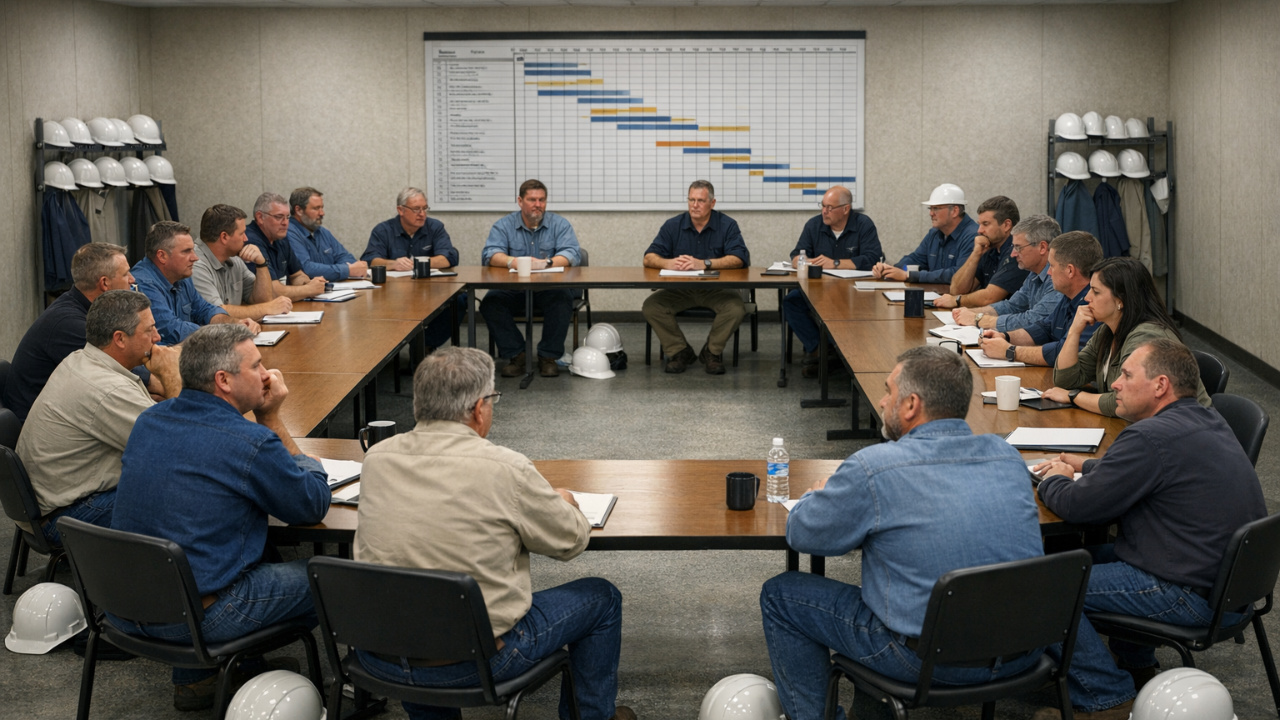
I’m going to use some large, high stakes examples throughout this series. Power plants. Manufacturing plants. Industrial shutdowns. Outages that cost hundreds of thousands or even millions of dollars a day when something slips.
But if you run a smaller business, I want you to stay right here with me.
Because anytime a meeting exists primarily to exchange updates and “ get everyone on the same page, ” the exact same mechanics show up. The scale is different. The pain is quieter. But the drain is just as real. It’s what turns a reasonable workday into evenings, weekends, and that nagging feeling that the real work always has to happen later.
So let’s talk about what meetings are really doing.
In high pressure environments — especially during outages or shutdowns — synchronization isn’t optional. Everyone genuinely needs to know what’s going on. What changed. What matters. And what decisions have already been made.
That part is obvious.
What’s less obvious is this.
Meetings didn’t become dominant because they’re efficient. They became dominant because information slowly scattered.
Updates drifted into email threads. Decisions got made in side chats. Clarifications happened in hallway conversations or quick phone calls. Status lived in spreadsheets on personal drives. Context spread across tools and systems that didn’t talk to each other.
As information became scattered and visibility eroded, leaders compensated the only way they could — by bringing people together more often and asking them to talk it out.
Meetings quietly became the glue holding the picture together.
The meeting was never the goal.
Orientation and synchronization were.
And once you see that distinction, things start to look very different.
Let me ground this with an example.
In large power plants, outages are among the most expensive, stressful events an organization can experience. Generating units are taken offline. Schedules are compressed. Every day of delay has real financial consequences. Leaders feel enormous pressure to keep everyone aligned.
So what do a lot of plants do?
They add meetings.
Sometimes they move from one outage meeting a day to two. On paper, that doesn’t sound terrible. Thirty minutes. Maybe an hour.
But the real cost isn’t the meeting itself.
It’s everything wrapped around it.
People have to stabilize their work before they leave the office or job site. Walk long distances across the facility. Step out of active problem solving. Sit through updates that only partially apply to them. Then walk back. Reload context. And get back into the real work.
Not once.
But over and over.
That’s not just time lost. That’s momentum broken.
This is the hidden cost most organizations never calculate: forced physical and cognitive disruption.
And here’s the key insight.
When updates only live inside meetings, meetings become mandatory. Not because leaders are controlling and not because people aren’t disciplined.
But because there is no other way to reconstruct reality.
So meetings quietly become a substitute for visibility.
This isn’t a people or discipline problem.
This is an information design problem.
Now, if you’re running a small business, this probably sounds familiar in a different form.
Maybe it’s the weekly staff update meeting. Or the recurring project sync. Or the owner — or one key employee — having to be in every conversation because they’re the only one who can reconstruct the full picture on the fly.
Different scale. Same mechanism.
Information isn’t visible unless people stop what they’re doing and assemble.
And once that’s true, disruption becomes baked into the system.
Throughout this series, I want you to hold on to one simple idea.
Synchronization is non negotiable. It’s mandatory. But… forced physical and cognitive disruption is not.
Everything we’re going to talk about in the next few episodes builds on that calm assertion — what changes when updates are captured deliberately, when context lives somewhere other than inside people’s heads, and when leaders don’t have to interrupt work just to get oriented.
And just to be clear, this doesn’t happen by accident. Information has to be written down clearly, stored predictably in a shared environment, and easy to retrieve.
That kind of environment has to be designed up front.
And yes — that’s the kind of work we spend our days doing around here. Most organizations have everything written down, but it’s scattered and not structured for today’s technological capabilities. As I’m fond of saying often, email is so 1990s!
In Part Two, we’re going to talk about what it looks like to replace the meeting itself without losing that precious alignment — in practice, grounded in real operations rather than abstract theory.
If this episode shifted how you think about meetings, stay with me. Over the next three episodes, we’ll walk through a practical alternative from end to end so meetings can finally do the work they were always meant to do.
This is Annie. I’ll see you next Monday and we’ll walk through this mindshift and propose a reasonable way forward.
Stay connected!
Join our mailing list to receive cutting edge content.
Don't worry, your information will not be shared.
Categories
All CategoriesThe Author

Arnie Howes
Arnie Howes has spent more than 25 years working with hundreds of organizations, using Microsoft collaborative technologies and Lean Office techniques to eliminate email overload and information chaos.
Receive cutting-edge content from the author!
