
AI Shouldn’t Mean Reducing Headcount Part 2
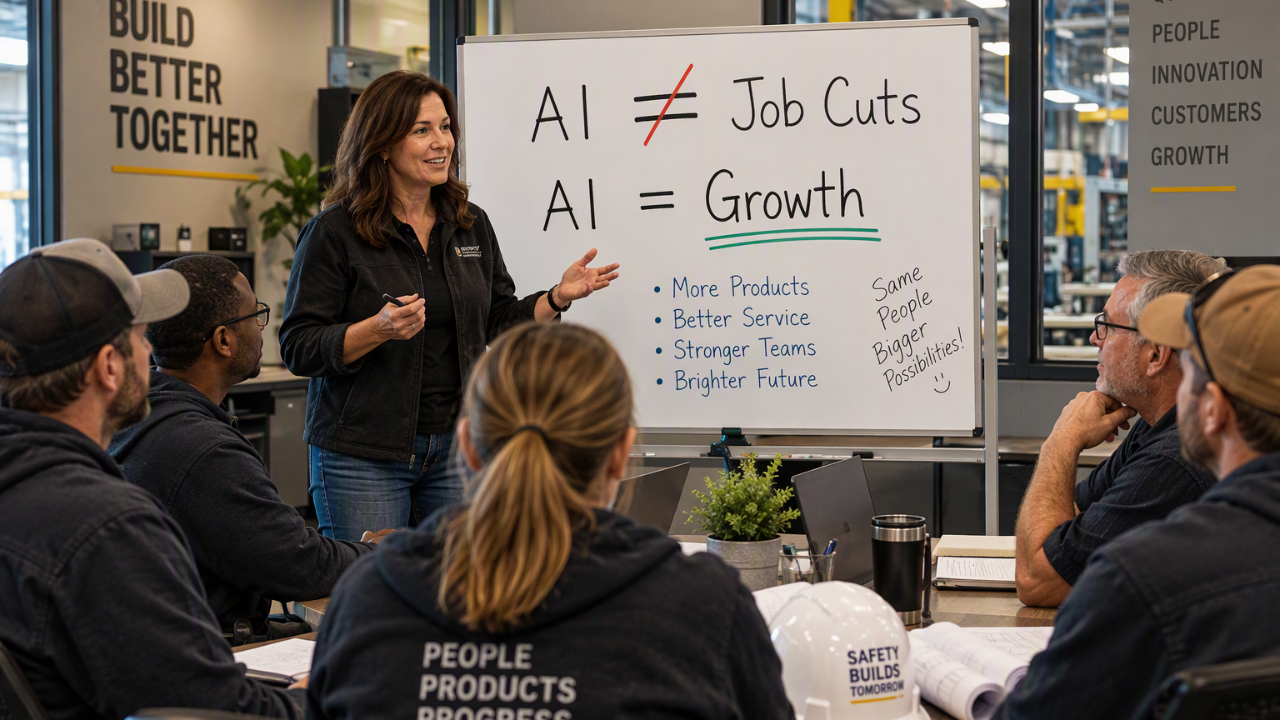
In the first installment, I suggested that we may be looking at one of the biggest benefits of AI from the wrong direction.
There is no question that AI can make people more productive. Tasks that once consumed a significant portion of someone's day can suddenly take minutes. That naturally creates an opportunity to reduce costs, and in some businesses that may make sense.
But it also creates an opportunity to increase output.
If AI gives your existing employees several hours of their week back, what else could those people accomplish with that time? What if the goal wasn't doing the same amount of work with fewer people, but figuring out how much more value the same people could create?
That's where this gets interesting.
Before looking at growth, however, I would spend a little time looking for friction. AI can certainly automate repetitive work, but don't limit your thinking to obvious administrative tasks. Look for the things that make work unnecessarily difficult: searching for information, summarizing material, reformatting documents, documenting activity, recreating work that already exists, or answering the same questions over and over.
Removing that kind of friction gives people time back, but it also makes work less frustrating. Even if you didn't accomplish anything else with AI, making everyday work easier for your employees would be a pretty good place to start.
If you're not sure where that friction exists, that's one of the reasons we created the free Business Friction Finder at BuildACalmerBusiness.com. It walks you through questions intended to help uncover the places where unnecessary work, scattered information, and confusion may be consuming time. The point isn't necessarily to find something for AI to automate. Sometimes the answer may be AI, while other times it may simply involve making better use of Microsoft 365 tools you're already paying for. [0131 - AI...art 2 Copy | Word]
Once you begin getting some of that time back, though, I think the more interesting question becomes what you do with it.
One obvious possibility is to turn saved time into customer time.
Most businesses would benefit from employees spending a little more time checking on customers, following up after a sale, solving problems before customers have to complain, or simply giving people the kind of personal attention that is so often missing today. Better customer care can lead to repeat business, referrals, and better reviews. Suddenly, time saved by AI isn't simply a reduction in labor expense. It becomes an opportunity to create customers who want to come back.
Another possibility is to invest some of that capacity into making good employees even better.
Perhaps you have someone who has always wanted to learn another part of the business. Maybe you have an employee who would benefit from cross-training, or someone who shows potential as a future leader but needs to develop particular skills.
AI creates some fascinating possibilities here.
You can describe what someone wants to learn and ask AI to help explore the subject with the employee. It can ask questions, suggest areas for development, help put together a learning plan, and provide supporting material along the way. Instead of thinking only about how AI can perform an employee's work, we can also ask how AI might help that employee become more capable.
Then there is an opportunity that should be painfully obvious.
Let your salespeople spend more time selling.
AI can help with research, preparation, paperwork, follow-up, and any number of activities surrounding the sales process. I suppose you could use all that increased productivity to make the same number of sales with fewer salespeople.
But why in the world would you automatically do that?
If you have good salespeople and can remove some of the things that keep them from talking to customers and pursuing opportunities, why not see how much more business they can generate?
The same thinking can be applied to whatever you already sell.
One of my favorite uses for AI is brainstorming and pressure-testing ideas. Describe a product and ask for ten non-obvious ways it might be improved. Most of those ideas probably won't be worth pursuing, and that's perfectly fine. Seven or eight may go nowhere. But another might cause someone on your team to say, "Wait a minute. What if we...?"
That's where things get interesting.
We use AI this way ourselves. I don't expect every answer to be brilliant. I'm looking for the unexpected thought that sends me in a direction I hadn't considered. Quite often, somewhere in the conversation there is at least one idea that really gets my attention.
You can do exactly the same thing with services.
In fact, AI may make some services possible that weren't financially practical before. Perhaps you've considered offering something customers would value, but delivering it required so many employee hours that you couldn't make the numbers work. If AI can now assist with a significant portion of that work, it may be worth pulling that old idea back off the shelf.
That is a very different form of productivity improvement. Nothing was eliminated. You created something that you couldn't profitably offer before.
You can take the exercise one step further. Describe your business, your current services, your customers, and the things you're particularly good at. Then ask your AI tool to suggest ten creative, non-obvious services that fit what you already do. Don't expect ten winners. You don't need ten winners.
You need one idea that causes you to stop and think.
And this is where I believe the AI conversation becomes much more interesting than simply calculating hours saved.
Someone whose administrative burden has been reduced might spend more time with customers. Another employee might develop a valuable new skill. Salespeople might pursue more opportunities. A team might improve an existing product. Something that was previously too expensive to offer might become a profitable new service.
None of those things appear on a spreadsheet labeled "headcount reduction."
They do, however, have the potential to show up as growth.
There is another benefit to this approach that shouldn't be overlooked. Employees are understandably nervous about AI when the only story they hear is that the technology will allow companies to accomplish the same amount of work with fewer people. If that is the message they receive, we probably shouldn't be surprised when they aren't particularly enthusiastic about helping management discover every possible productivity improvement.
The conversation becomes very different when leaders genuinely mean something else.
If the message is that we're trying to remove frustrating work, help people become more capable, serve customers better, create new opportunities, and grow the business, employees have a reason to participate in finding those opportunities. That doesn't mean promising that nothing will ever change. It simply means being honest about what you're trying to accomplish.
Which brings me back to the farming analogy from Part 1, because I think it explains this entire mindset better than almost anything else.
If a farmer down the road discovers a miracle fertilizer that doubles his yield, none of us believes for a second that he'd sell off half his farm simply because he can now produce the same amount of grain on half the acres.
He'd keep the acres and grow more grain.
AI is giving businesses the possibility of a larger harvest. Before immediately deciding which employees are no longer necessary, it might be worth asking what else those employees could produce, sell, improve, create, or deliver with their newly available capacity.
Perhaps that's the simpler way to think about all of this.
Grow your business. Don't cut your employees.
Stay connected!
Join our mailing list to receive cutting edge content.
Don't worry, your information will not be shared.
Categories
All CategoriesThe Author

Arnie Howes
Arnie Howes has spent more than 25 years working with hundreds of organizations, using Microsoft collaborative technologies and Lean Office techniques to eliminate email overload and information chaos.
Receive cutting-edge content from the author!
