
What If AI Isn't About Cutting Costs?
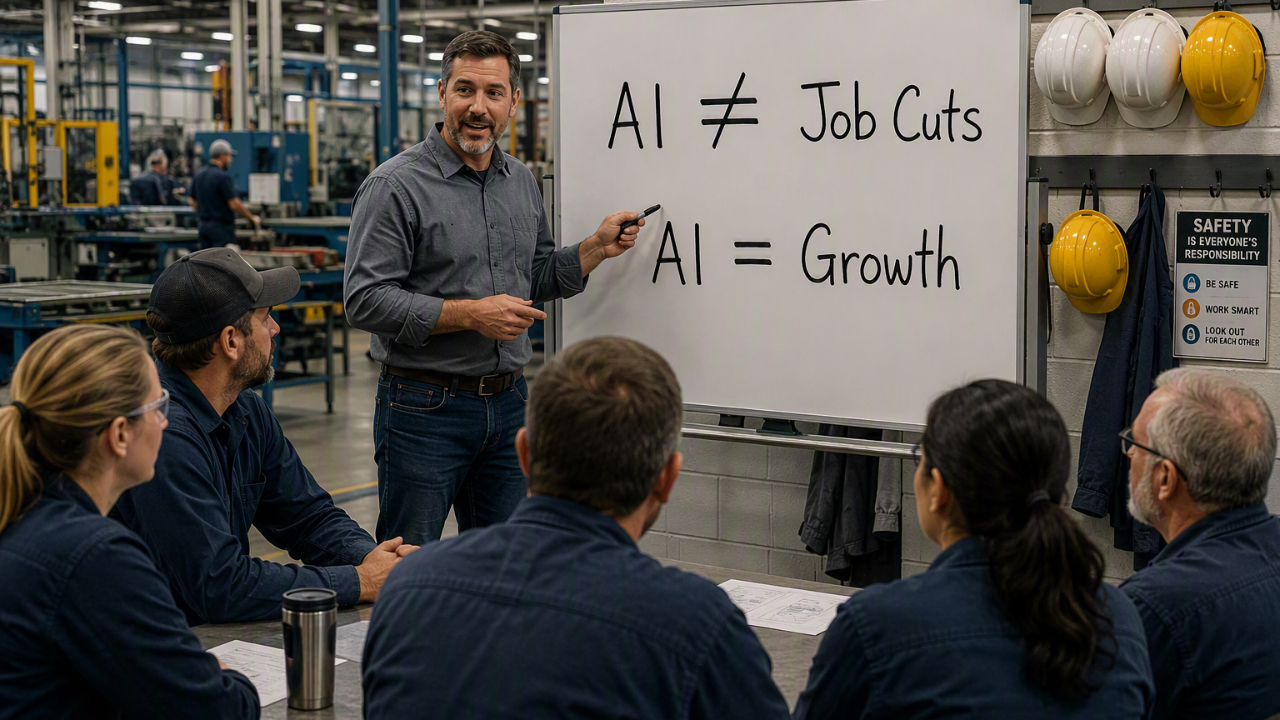
When most people talk about AI in business, the conversation usually turns to efficiency. The software can summarize documents, answer questions, draft responses, analyze information, and perform tasks that used to take employees considerable time. It doesn't take long before someone asks the obvious question: "If my people can get more done, do I still need all of them?"
I understand why that question comes up. If productivity goes up, reducing costs is certainly one possible response. What interests me, however, is the fact that it is not the only response.
A few weeks ago I found myself thinking about a farming analogy. Suppose a farmer discovered a fertilizer that increased crop yields four or five times over what he was getting before. He could certainly sell off most of his acreage and continue producing the same amount of grain. That would be one option.
But why would he?
Most farmers I know would be far more interested in what additional production that new capability might create. They would look at the same land, the same equipment, and the same operation and start asking themselves how much more value might be possible.
That is what I think many businesses are missing in the current AI conversation.
When a company discovers a tool that allows its people to spend less time searching for information, rewriting documents, answering routine questions, preparing reports, or performing other repetitive work, the immediate assumption is often that fewer people will eventually be needed. Yet there is another possibility. What if the time saved becomes available for better customer service, stronger follow-up, additional sales activity, employee development, process improvement, or entirely new offerings?
Stated differently, increased productivity gives leaders a choice. They can reduce resources, or they can increase value.
The reason I find this perspective important is because AI still depends heavily on people. Despite the headlines, today's organizations still run on judgment, experience, relationships, trust, and the countless small decisions that happen throughout a normal workday. AI can support those activities. It can accelerate them. It can often improve them. But it has not eliminated the need for them.
There is also a human side of this discussion that deserves attention. Employees are not blind. They hear the same conversations that business leaders hear. When AI enters the workplace, many immediately wonder what it means for their jobs. Even when leaders have no intention of reducing staff, that concern can affect adoption. People are understandably less enthusiastic about discovering efficiencies if they suspect those efficiencies may eventually eliminate their positions.
Perhaps there is a better message.
Instead of presenting AI as a way to remove people, what if organizations presented it as a way to remove busywork? Most employees would gladly spend less time on low-value administrative tasks and more time helping customers, solving problems, learning new skills, and contributing in meaningful ways. The time recovered through AI does not have to disappear from payroll. It can become capacity that helps the business grow.
That shift in thinking changes the entire conversation. Instead of asking, "How many dollars can we save?" leaders begin asking, "How much additional value can our existing team create?"
Those are very different questions, and they often lead to very different decisions.
Next week we'll explore the practical side of this idea. If a business chooses to pursue growth rather than immediate workforce reduction, what does that actually look like? We'll walk through several specific examples of how organizations can use AI to increase value, improve service, and strengthen their people without immediately shrinking the workforce.
Stay connected!
Join our mailing list to receive cutting edge content.
Don't worry, your information will not be shared.
Categories
All CategoriesThe Author

Arnie Howes
Arnie Howes has spent more than 25 years working with hundreds of organizations, using Microsoft collaborative technologies and Lean Office techniques to eliminate email overload and information chaos.
Receive cutting-edge content from the author!
