
The Cost of a Click
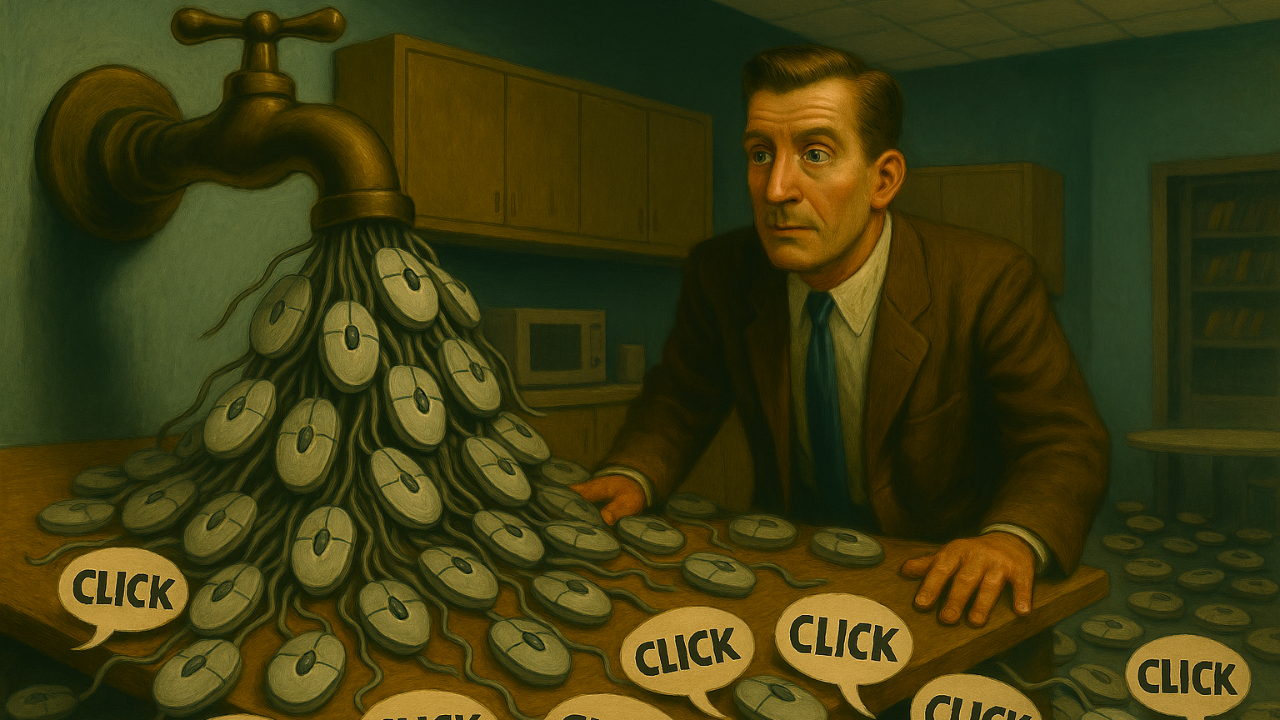
Ever hear a faucet drip in the middle of the night? One little plink, then another. Harmless, right? But let that drip keep going—24 hours a day, 31 days straight—and you’ll have a water bill that makes you spit out your coffee.
Clicks work the same way. Each one feels insignificant, but thousands of clicks a day add up to something far more costly than wasted time: decision fatigue. Every click is a micro-decision—where to aim, what to select, what comes next. Multiply that by thousands, and you’ve got a silent drain on your team’s mental energy.
Decision Fatigue: The Invisible Productivity Killer
Studies estimate adults make about 35,000 decisions a day. Office workers? They live in the land of micro-decisions: 2,000–3,000 conscious choices daily, plus 1,500–7,000 mouse clicks. Each click fractures focus and burns cognitive fuel.
When the brain’s decision-making center runs low on energy, people default to shortcuts, easy options, or no decision at all. That’s why your team feels mentally exhausted by 3 PM—even when the tasks seem simple. It’s not the big projects that drain them; it’s the constant stream of tiny choices.
Why This Matters for Leaders
Attention is the currency of creativity. Every unnecessary click is churn—time spent searching instead of creating, innovating, or strategizing. Imagine a team of 20 people spending just 10 minutes a day hunting for files. Over 250 workdays, that’s 833 hours lost. Hours that could have fueled growth and morale instead of frustration.
This isn’t about technology for technology’s sake. It’s about management. Designing systems that protect mental energy is a leadership responsibility. When energy leaks away through micro-decisions, you pay the price—in productivity, creativity, and retention.
How to Stop the Leaks
The solution isn’t another shiny app. It’s smarter systems. Start by tightening the faucet:
- Consolidate workflows so employees aren’t bouncing between tools.
- Use Teams as a true hub, not just a meeting app.
- Build metadata into document libraries so people filter instead of hunt. Hunting is death by a thousand clicks; metadata is clarity.
When your Teams environment is structured strategically, it becomes an aggregation powerhouse—a switchboard that eats clicks for breakfast. That’s how you preserve attention and keep your team focused on work that matters.
Your Challenge
Audit your clicks. Count them. Then ask: What would it take to cut them in half? Maybe it’s better tools. Maybe it’s better habits. Maybe it’s finally using Teams the way it was meant to be used.
Because the future of work isn’t about working harder—it’s about working smarter. And that starts with eliminating a single click.
Stay connected!
Join our mailing list to receive cutting edge content.
Don't worry, your information will not be shared.
Categories
All CategoriesThe Author

Arnie Howes
Arnie Howes has spent more than 25 years working with hundreds of organizations, using Microsoft collaborative technologies and Lean Office techniques to eliminate email overload and information chaos.
Receive cutting-edge content from the author!
